 |
| Swan Lake |
|
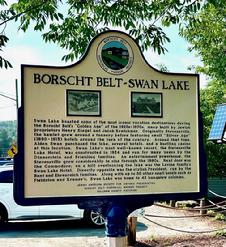
| Borscht Belt - Swan Lake
Swan Lake boasted some of the most iconic vacation destinations during the Borscht Belt's "Golden Age" of the 1920s-1970s, many built by Jewish proprietors Henry Siegel and Jacob Kretchmer. Originally Stevensville, the hamlet grew around a tannery before featuring small "Silver Age"(1890-1915) hotels around the turn of the century. Around that time, Alden Swan purchased the lake, several hotels, and a bustling casino at this location. Swan Lake's most well-known resort, the Stevensville Lake Hotel, was constructed in 1924 and run for many years by the Dinnerstein and Friehling families. An entertainment powerhouse, the Stevensville grew considerably in size through the 1980s. Next door was the Commodore; on a hill overlooking the lake was the Levine family's Swan Lake Hotel. Directly opposite was the stylish President, run by the Bant and Ehrenreich families. Along with up to 30 other small hotels such as Fieldstone Kramer's. Swan Lake was home to 42 bungalow colonies.
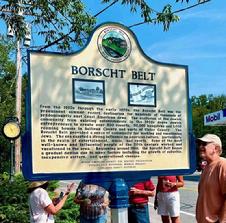
Borscht Belt
From the 1920s through the 1970s, the Borscht Belt was the preemnent summer resort destination for hundreds of thousands of predominantly east coast American Jews. The exclusion of the Jewish community from existing establishments in the 1920s drove Jewish entrepreneurs to create over 500 resorts, 50,000 bungalows and 1,000 rooming houses in Sullivan County and parts of Ulster County. The Borscht Belt provided a sense of community for working and vacationing Jews. The era exerted a strong influence on American culture, particularly in the realm of entertainment, music, and sports. Some of the most well-known and influential people of the 20th century worked and vacationed in the areas. Beginning around 1960, the Borscht Belt began a gradual demise due to many factors including the growth of suburbia, inexpensive airfare and generation changes.
Erected 2023 by Jewish American Society for Historic Preservation, the Borscht Belt Historical Marker Project, Sullivan County Historian.
|